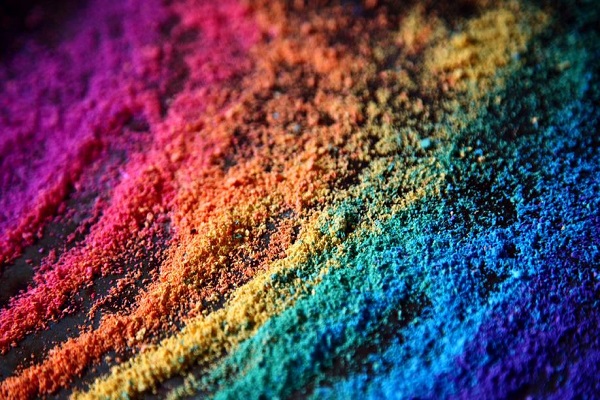
In a reactive dye, a chromophore has a substituent that responds with the substrate. Reactive dyes have great fastness properties owing to the covalent bonding that happens during coloring. Reactive dyes are commonly used in the dyeing of cellulose like cotton or flax, but also wool is dyeable with reactive dyes. Reactive dyeing is one of the most important methods for the pigmentation of cellulosic fibers. Reactive dyes can also be applied on woolen and nylon; in the latter case, they are used under weakly acidic problems.
Classification Of Reactive Dyes:
Depending on chemical constitution reactive dyes can be identified as:
•Chlorotriazine Dyes (MCT)
•Vinyl Sulphone Dyes (VS)
•Heterocyclic Halogen Including Dyes (HHC)
•Mixed Dyes (MCT-VS)
Depending on application approaches of temperature, reactive dyes can be identified as:
1.Cold Reactive Dyes: This type of reactive dye is used at extremely low temperatures. The temperature level lies between 25 – and 50 levels Celsius. They are extremely reactive with fiber at this temperature level.
2.Medium Reactive Dyes: This type of dye is used in a medium temperature level range of 40 – 60 degrees Celsius. Their reactivity is a medium with fiber.
3.Low Reactive Dyes: This type of dyes has extremely low reactivity properties with fiber in contrast with the medium and high reactive dyes.
Properties Of Reactive Dyes:
•Reactive dye is organic
•Reactive dye is a water-soluble dye
•They have clean and fastness properties
•They have better substantivity
•They form a strong covalent bond with the cellulosic fiber
•A variety of colors can be produced with reactive dyes
•Affordable in cost
USES REACTIVE DYES:
1.Reactive dyes are used where intense dyeing with light & clean fastness is needed.
2.Cold coloring is used extensively in batik works.
3.Although some reactive dyestuff has been specifically changed to dye woolen, their primary usage remains in coloring cotton linen & viscose rayon.
4.Dyeing of cotton with reactive dyes.
BENEFITS OF REACTIVE DYES:
1.Permanency of the color:
Fiber Reactive Dyes can be conveniently said to be the most irreversible of all dye kinds. This is a result of a special high quality, unlike various other dyes, it can form a covalent bond with the substrate (cellulose or protein molecule). After the formation of the bond. there is only one molecule, as the molecule is now part of the cellulose fiber molecule.
2.Easy Washing:
The fibers that are colored with fiber reactive dyes can be safely colored despite having white garments without the danger of coloring them.
3.Chemical Binding:
The chemical bonds as explained over substantially boosts the product’s color safety and washability. Therefore, no doubt reactive dyeing of cotton is one of the most popular fabric coloring processes on the planet.

 Our Content Blogs