Meta Title: No Tax on Tips 2026 | Paycheck & W-2 Rules
Meta Description: Learn why tips can still be taxed on your paycheck in 2026, who may qualify for the $25,000 deduction, and what W-4, Code TP, and Box 14b mean.
You heard about “No Tax on Tips,” checked your next paycheck, and taxes were still coming out of your tip income.
So what happened?
The phrase can make the new rule sound much simpler than it actually is. No Tax on Tips does not mean every tip disappears from payroll taxes or that employers stop reporting tipped income.
For eligible workers, the law creates a federal income tax deduction for qualified tips. Payroll reporting, Social Security tax, Medicare tax, and other rules still matter.
Here is what tipped workers should understand in 2026.
What Does No Tax on Tips Actually Mean?
Eligible employees and self-employed workers may be able to deduct up to $25,000 of qualified tips from income for federal income tax purposes.
The deduction applies to workers in qualifying occupations that traditionally received tips.
That can include workers in occupations such as restaurant service, bartending, personal care, hospitality, transportation, and other qualifying tipped jobs.
But the deduction is not the same as saying:
“The first $25,000 of tips is never taxed through payroll.”
Tips are still reported as income. Employers still have payroll responsibilities, and the worker must meet the eligibility rules to claim the deduction.
Why Are Taxes Still Coming Out of My Tips?
This is the biggest source of confusion.
Even if you may eventually qualify for the tip deduction, your employer can still withhold taxes from your paycheck.
Tips are generally still subject to Social Security and Medicare taxes when the applicable payroll rules are met.
If you see Social Security or Medicare deductions beside your tip earnings, that does not automatically mean payroll made a mistake.
For more information about these two payroll taxes, see the ePaystubs guide to FICA on a pay stub.
Federal income tax withholding can also continue unless your withholding setup appropriately accounts for the new deduction.
Which Tips Qualify?
The rules focus on qualified tips.
Generally, these are voluntary cash tips or charged tips left by customers. Tip-sharing amounts received by employees may also qualify.
The word “voluntary” matters.
Suppose a restaurant customer chooses to leave a server a $20 tip. That may be a qualified tip if the other requirements are met.
Now imagine the restaurant automatically adds a mandatory 20% service charge to every table.
That mandatory charge is not treated the same way as a voluntary tip for this deduction.
Employees should therefore avoid assuming that every amount described casually as a gratuity qualifies.
How Much Can You Deduct?
The maximum annual qualified-tip deduction is generally $25,000.
The amount may be limited depending on the worker’s income and other eligibility rules.
The deduction begins to phase out when modified adjusted gross income exceeds $150,000, or $300,000 for married couples filing jointly.
A married taxpayer generally must file jointly to claim the deduction.
The worker also needs a valid Social Security number.
Most employees will not need to calculate all of these limitations every payday. What matters is understanding that $25,000 is a maximum deduction, not a guaranteed tax-free payment for everyone.
Can You Change Your W-4 in 2026?
Yes, and this is one of the biggest payroll changes for 2026.
The 2026 Form W-4 Deductions Worksheet includes a line for estimating qualified tips.
A worker who expects to qualify may be able to account for estimated qualified tips through an updated W-4. That can affect federal income tax withholding during the year.
In simple terms, an employee may not have to wait until filing a tax return to receive the entire federal withholding benefit.
That does not mean everyone should immediately enter $25,000.
The amount entered should reflect the worker’s expected qualified tips and eligibility.
If you are unsure what FIT or federal withholding represents on your paycheck, read what FIT or FWT means on a pay stub.
Example: A Server Earns $18,000 in Tips
Consider a restaurant server who earns regular wages plus $18,000 in qualifying voluntary tips during 2026.
Assume the worker otherwise meets the deduction requirements.
The employee could potentially qualify for a deduction based on those qualified tips, subject to the applicable limitations.
However, that does not mean the employee’s pay stubs will show zero payroll tax on the $18,000.
Social Security and Medicare treatment still applies under payroll rules.
The employee may also see federal withholding during the year depending on the Form W-4 on file and how withholding has been calculated.
This distinction is why the words “No Tax on Tips” can be misleading when someone looks only at one paycheck.
What Is Code TP on the 2026 W-2?
Workers should also expect changes when they receive their 2026 Form W-2.
A new Code TP in Box 12 is used to report the total amount of cash tips reported to the employer.
That figure matters because tipped income must be properly reported.
Do not confuse Code TP with a new payroll deduction. It is a reporting code.
If you are unfamiliar with the different sections of the form, see the ePaystubs guide to W-2 boxes and codes.
What Is Box 14b?
The 2026 W-2 also introduces Box 14b for a Treasury Tipped Occupation Code.
This helps identify the occupation in which the reported tips were earned.
The occupation is important because the deduction is tied to qualifying tipped occupations.
Workers should review this information when their W-2 arrives rather than checking only total wages.
If the tip amount or occupation information appears incorrect, contact the employer or payroll department rather than simply changing the figures when filing a return.
Check Your Pay Stub Before Assuming Something Is Wrong
Seeing taxes beside tip earnings in 2026 does not mean the No Tax on Tips deduction disappeared.
The deduction affects federal income tax treatment for eligible qualified tips. It does not simply erase tipped income from payroll.
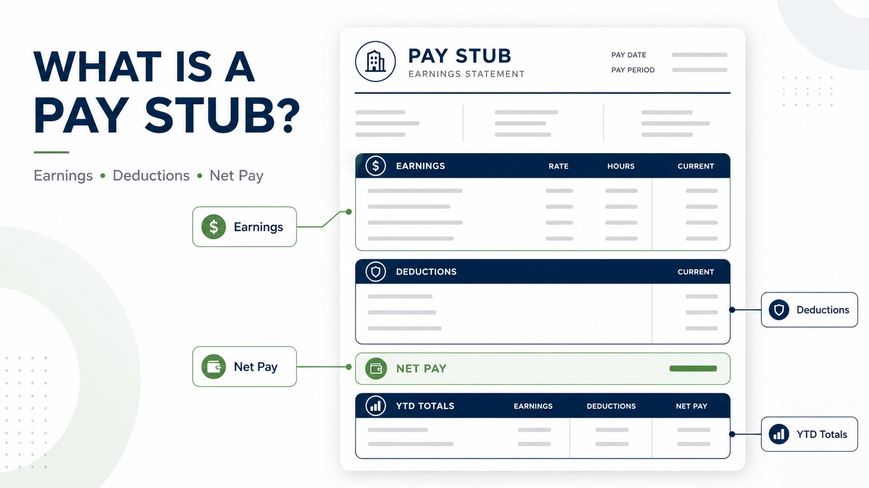
Check your regular wages, tips reported, federal withholding, Social Security, Medicare, and year-to-date totals separately.
Employers who need legitimate payroll records can use the ePaystubs online pay stub generator to create pay stubs using accurate employee wages, tips, taxes, and deduction information.


