Sydney Kitchen Designers | Custom Kitchen Specialists

Work with experienced Sydney kitchen designers at Premier Kitchens to create a kitchen tailored to your home, lifestyle and style. From smart layouts and practical storage to cabinetry, benchtops and finishes, the team guides you through each design decision before your custom kitchen is manufactured in Premier Kitchens’ own Sydney factory.

Employer Adoption Benefits in 2026: Why W-2 Code T Can Be Larger Than $17,670

An employer pays $12,000 toward an employee’s adoption expenses. Later, another $7,000 is reimbursed after additional legal and travel costs are approved.

The employee’s Form W-2 eventually shows Code T: $19,000.

That may look wrong because the 2026 federal adoption-assistance exclusion is $17,670. But Code T is not simply a box showing the tax-free portion.

Employers generally report qualifying adoption-assistance payments made or reimbursed under the program in Box 12 using Code T, even when the total is above the federal exclusion.

Understanding that difference can prevent a common W-2 reporting mistake.

What Is Employer Adoption Assistance?

An employer adoption-assistance program is a written benefit plan that helps employees pay qualified expenses connected with adopting an eligible child.

The program may reimburse adoption fees, court costs, legal expenses, travel costs and other qualifying expenses under federal rules.

It is not the same as giving an employee a normal bonus.

The written plan matters, and the employer must follow federal requirements, including rules designed to prevent the benefit from unfairly favoring highly compensated employees.

From a payroll perspective, adoption assistance should also be kept separate from ordinary earnings. The ePaystubs guide to gross pay versus net pay can help employees understand why a benefit may affect taxable wages without increasing take-home pay by the same amount.

The 2026 Exclusion Is $17,670

For 2026, the maximum amount that can generally be excluded from an employee’s gross income for qualifying employer-provided adoption assistance is $17,670 per eligible child, subject to the applicable income limits and other requirements.

Suppose an employer reimburses $10,000 of qualifying adoption expenses.

If the employee otherwise qualifies, that amount may fall within the federal exclusion.

Now suppose the employer reimburses $20,000.

The full $20,000 does not automatically become tax-free simply because it came through an adoption-assistance program.

The exclusion has a limit.

Payroll therefore needs to distinguish between the total benefit provided and the amount that may ultimately qualify for exclusion.

Code T Can Still Show $20,000

This is the part that causes confusion.

The employer generally reports qualifying adoption-assistance payments in Form W-2 Box 12 using Code T.

That reporting amount can be higher than $17,670.

For example:

Box 12 Code T: $20,000

can be correct even though the federal exclusion is $17,670.

Code T reports the adoption benefit provided by the employer. It does not guarantee that every dollar is excluded from the employee’s federal income.

The employee generally determines the final treatment when completing the federal tax return.

Employees who want to understand other Box 12 entries can review the ePaystubs guide to W-2 boxes and Box 12 codes.

Federal Income Tax and FICA Treat the Benefit Differently

Another important point is that federal income tax and payroll taxes do not necessarily treat adoption assistance the same way.

Qualifying employer-provided adoption assistance can generally be excluded from wages subject to federal income tax withholding when the requirements are satisfied.

However, Social Security and Medicare taxes can still apply.

Imagine an employer reimburses an employee $5,000 for qualifying adoption expenses.

Federal income tax withholding may not apply to the qualifying excluded benefit.

Social Security and Medicare taxes may still be calculated on the amount.

That can make the paycheck look strange.

An employee may wonder why no additional federal income tax was withheld while Social Security and Medicare deductions increased.

The ePaystubs guide to FICA on a pay stub explains why these taxes can follow different wage rules.

Why Code T May Not Match Box 1

This difference also explains why Form W-2 boxes do not always match.

Code T reports the adoption-assistance benefit.

Box 1 reports federal taxable wages.

Box 3 reports Social Security wages.

Box 5 reports Medicare wages.

Because qualifying adoption assistance may receive one treatment for federal income tax and another treatment for Social Security and Medicare taxes, the same benefit can affect those boxes differently.

Payroll teams should not assume that Box 1, Box 3 and Box 5 must always be identical.

The ePaystubs guide to taxable wages and W-2 box differences can help explain why these amounts sometimes differ.

The Plan Cannot Mainly Benefit Owners

A qualifying adoption-assistance program has nondiscrimination rules.

The employer cannot simply create a plan that exists mainly to reimburse owners, shareholders or highly compensated employees.

This is especially important for small and closely held businesses.

Benefits and eligibility should follow the written plan, and payroll should keep the supporting documentation with the reimbursement records.

A payment labeled “adoption reimbursement” is not automatically entitled to favorable federal treatment.

The plan itself must qualify.

Special Rule for S Corporation Shareholders

More-than-2% S corporation shareholders can receive different fringe-benefit treatment.

For adoption-assistance purposes, a more-than-2% shareholder generally is not treated the same way as an ordinary employee for the exclusion.

This can easily be missed because the shareholder may receive a W-2 and appear in payroll like every other employee.

Before processing an adoption reimbursement for an owner or shareholder, payroll should verify ownership status rather than assuming the normal employee rules apply.

Adoption Assistance Is Not the Same as the Adoption Credit

Employer adoption assistance and the individual adoption tax credit are connected, but they are not the same benefit.

For 2026, the federal adoption credit also uses a maximum qualified-expense amount of $17,670, subject to the applicable rules.

An employee cannot simply use the same expense twice to receive both a tax-free employer benefit and an adoption credit.

Form 8839 is generally used to determine the adoption credit and the treatment of employer-provided adoption benefits.

Payroll’s job is to report the employer benefit correctly.

The employee’s tax return determines the final personal tax result.

Keep the Records During the Year

Employers should keep the written adoption-assistance plan, employee eligibility information, reimbursement requests and documentation supporting qualified expenses.

Do not wait until W-2 season to determine the Code T amount.

Track reimbursements as they happen.

At year-end, compare the amount the employer paid with the Code T total and verify that Social Security and Medicare wages were handled properly.

The ePaystubs guide to current and YTD amounts on a pay stub can also help employees understand how benefits and payroll taxes accumulate during the year.

Employers preparing year-end wage records can use the ePaystubs W-2 form generator after all payroll figures have been reconciled.

I hope you find the blog useful. Thanks for reading this blog.

Standard Deduction or Schedule A in 2026? The $40,400 SALT Cap Changes the Math

Choosing between the standard deduction and itemizing is one of the first real decisions on Form 1040. In 2026, that comparison deserves a fresh look. The standard deduction increased again, but the limit on state and local tax deductions also moved much higher. The key is not whether you have one large expense. It is whether your allowed itemized deductions, taken together, are larger than the standard deduction available for your filing status.

Start With the 2026 Standard Deduction

For tax year 2026, the standard deduction is $16,100 for single filers and married people filing separately, $32,200 for married couples filing jointly, and $24,150 for heads of household.

A single filer with only $7,000 of potentially deductible expenses would usually have little reason to give up a $16,100 standard deduction just to itemize $7,000. A homeowner with $28,000 or $35,000 of allowable Schedule A expenses has a very different calculation.

The ePaystubs 1040 Schedule A form can help organize itemized deductions once you know which expenses belong in the calculation.

The SALT Limit Is Much Higher in 2026

One of the biggest changes is the state and local tax deduction, often called SALT.

For 2026, the overall federal limit is $40,400, or $20,200 for married taxpayers filing separately. The limit begins to phase down when modified adjusted gross income exceeds $505,000, or $252,500 for married filing separately, but it cannot fall below $10,000 or $5,000 respectively.

SALT can include qualifying state and local income taxes or sales taxes, plus real estate and certain personal property taxes. For a homeowner who previously hit the old $10,000 ceiling, the higher 2026 limit can materially change whether itemizing beats the standard deduction.

Run the Numbers Instead of Guessing

Consider a single homeowner with the following potentially deductible amounts:

State and local taxes: $15,000
Home mortgage interest: $9,500
Cash charitable contributions before applicable limits: $2,500

That is $27,000 before considering any deductible medical expenses or other Schedule A items.

The 2026 standard deduction for a single filer is $16,100. If all $27,000 is allowable after the applicable rules and limitations, itemizing could reduce taxable income by considerably more than the standard deduction.

Now change the example. Suppose the same taxpayer has $8,000 of state and local taxes, no mortgage, and $1,200 of charitable giving. Even though those are real expenses, the total may still be well below $16,100.

Having deductions does not automatically mean itemizing is better.

Medical Bills Have Their Own Threshold

Medical expenses are another area where taxpayers sometimes overestimate the Schedule A deduction.

You can generally deduct only qualifying medical and dental expenses that exceed 7.5% of adjusted gross income when you itemize.

If your AGI is $80,000, 7.5% is $6,000. If you had $8,500 of otherwise qualifying unreimbursed medical expenses, only $2,500 would be above that floor.

Keep statements and receipts because reimbursements can change the deductible amount.

Charitable Giving Changed Too

Charitable contributions need an extra check in 2026.

For taxpayers who itemize, the new rules generally allow a charitable deduction only for contributions above 0.5% of AGI. That floor is applied before the deductible amount reaches Schedule A.

For example, 0.5% of a $100,000 AGI is $500. If the taxpayer makes $3,000 of contributions that otherwise qualify, the new floor can affect how much enters the itemized deduction calculation.

This is one reason copying last year’s Schedule A numbers into a 2026 estimate can produce the wrong answer.

High-Income Filers Have Another Limitation

There is also a broader 2026 limitation for certain higher-income taxpayers.

Publication 505 explains that total itemized deductions may be reduced when taxable income exceeds $640,600 for single or head-of-household filers, $768,700 for married couples filing jointly or qualifying surviving spouses, and $384,350 for married filing separately.

For taxpayers above those levels, the final Schedule A deduction may therefore be smaller than the simple total of all qualifying expenses.

Married filing separately has one extra wrinkle. If one spouse itemizes deductions on a separate return, the other spouse generally cannot take the standard deduction and must itemize too.

That can change the decision even when one spouse’s personal deduction total looks small.

Keep the Documents Before You Need Them

The best time to decide whether to itemize is not the best time to start looking for records.

Keep property-tax statements, mortgage interest documents, charitable receipts, and medical records throughout the year. Your pay records can also help with the bigger picture. The ePaystubs guide to gross pay versus net pay is useful when comparing wages with the income figures that eventually flow into a tax return.

Do not use a pay stub as a substitute for a year-end W-2, but it can help you notice whether income, withholding, or year-to-date totals changed enough to affect your planning.

The Better Choice Is the Larger Allowed Deduction

The standard deduction is simple. Schedule A is more detailed. Neither one is automatically better. For 2026, start with the standard deduction for your filing status. Then total only the Schedule A deductions you are actually allowed to claim after the applicable limits.

The higher $40,400 SALT cap means some taxpayers who stopped itemizing in earlier years may want to run the comparison again. Do not choose based on habit. Choose based on the numbers that apply to your 2026 return.

What Is Imputed Income on Your Pay Stub? The “IMP” Line That Taxes You on Money You Never Got

Meta Title: What Is Imputed Income on a Pay Stub? IMP & GTL Explained

Meta Description: Imputed income is the taxable value of a non-cash benefit like group-term life over $50,000. See why it’s on your stub and how it’s taxed.

Here’s one of the strangest lines on a pay stub. You spot “IMP,” “Imputed Income,” or maybe “GTL,” and it’s adding to your income, yet your take-home didn’t go up by a cent. If anything, it went down a little. So you’re being taxed on money you never actually received? Yes, and once you know why, it makes more sense than it looks. Here’s what imputed income is, where it comes from, and how it quietly nudges your paycheck.

The short answer

Imputed income is the taxable value of a non-cash benefit your employer gives you. The IRS treats certain perks as a form of pay, so their value gets added to your taxable wages even though you never see the cash. You then owe income tax, and usually Social Security and Medicare tax, on that value. It shows up on your stub so the taxes can be calculated, not because money is being taken out and handed to you.

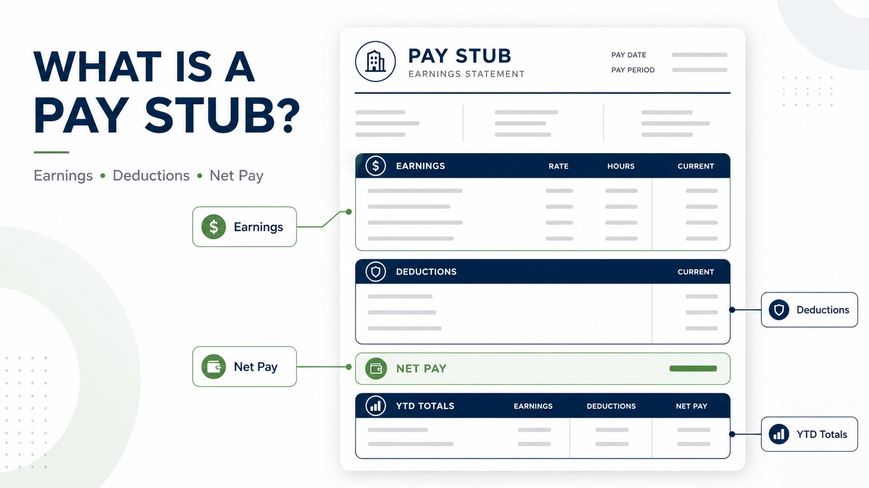
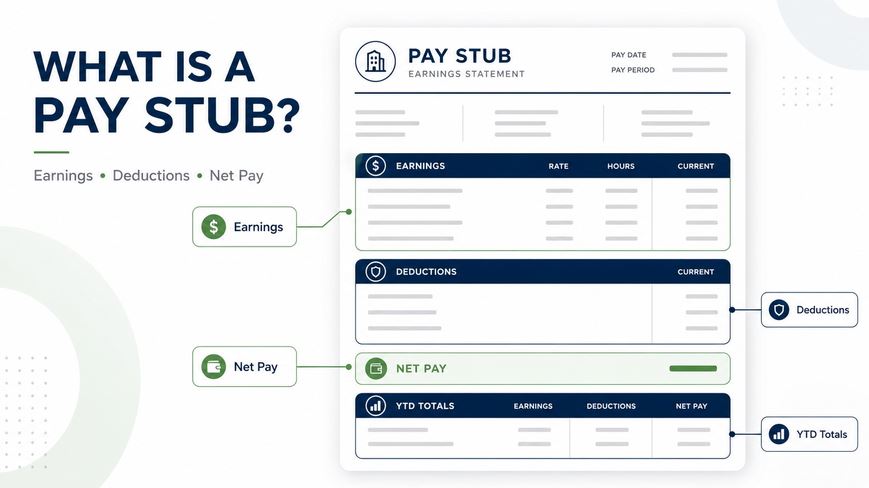
You’ll usually spot it in your earnings or a fringe-benefit section, labeled something like IMP, Imputed Income, GTL, or Fringe. If your stub is a maze of abbreviations, a labeled walkthrough of a pay stub shows where a line like this sits, and a guide to what every part of a pay stub means helps place the rest.

Why you’re taxed on something you didn’t receive

The logic is that a valuable benefit is really compensation in a different form. If your employer handed you $1,000 in cash, you’d expect to pay tax on it. The IRS reasons that giving you $1,000 worth of something, a benefit with real market value, is the same thing, so it gets taxed too. A handful of perks are specifically singled out for this treatment. The rest of your benefits, like your regular health insurance, are tax-free and never generate imputed income.

The most common source: group-term life insurance over $50,000

If you have employer-provided life insurance, this is probably why you see imputed income. The IRS gives you a break on the first $50,000 of employer group-term life coverage; that much is completely tax-free. But once your coverage tops $50,000, the value of the extra coverage becomes imputed income.

Here’s the twist: it isn’t based on what the insurance actually costs. The IRS uses its own age-based Uniform Premium Table, found in Publication 15-B, that sets a monthly cost per $1,000 of coverage above the $50,000 line. The older you are, the higher the rate.

A quick example. Say you’re 45 with $100,000 in employer life coverage. The first $50,000 is free, leaving $50,000 of taxable coverage. That’s 50 units of $1,000, and the table rate at age 45 is $0.15 per unit per month. So your imputed income is 50 times $0.15, or $7.50 a month, about $90 for the year. Small, but it’s why “GTL” or “IMP Life” shows up on your stub. And it’s subject to both income tax and FICA.

Other things that create imputed income

Group-term life is the big one, but a few other perks trigger it too:

  • Personal use of a company car. The value of using a company vehicle for non-work driving is imputed income.
  • Domestic partner health coverage. If you cover a partner who isn’t your tax dependent, the employer’s cost of their coverage is usually imputed to you.
  • Dependent or spousal life insurance over $2,000. Unlike your own $50,000 break, coverage on a spouse or dependent over $2,000 is taxable from the first dollar.
  • Gym memberships, certain wellness rewards, adoption or education assistance above IRS limits, and other fringe benefits, depending on the perk.

If a benefit has real cash value and isn’t on the IRS’s tax-free list, there’s a good chance part of it lands as imputed income.

How it actually hits your paycheck

This is the part that confuses people, so here’s what’s really happening. Imputed income gets added to your taxable wages, but you don’t receive it as cash. So your employer calculates the income tax and FICA owed on that value and withholds those taxes from your regular pay.

The result: your take-home drops by the tax on the benefit, not by the full value of the benefit. On the $7.50-a-month example, you’re not losing $7.50; you’re losing the tax on $7.50, which is pocket change. But on a bigger item, like heavy personal use of a company car, the tax can be noticeable. That’s why imputed income can make your net pay a little lower than you’d expect from your salary alone, and why it looks like a deduction for something you never bought. If you’re trying to square your gross pay with your take-home net pay, imputed income is one of the sneaky reasons they don’t line up cleanly, and since most of it is subject to Social Security and Medicare tax, it nudges those lines up a touch too.

Where imputed income shows up on your W-2

Come tax time, imputed income doesn’t just vanish. For group-term life over $50,000, the amount appears in Box 12 with code C, and it’s also baked into your total wages in Boxes 1, 3, and 5. Other types often show up in Box 14. It’s already included in the wage figures you file with, so you don’t add it again; it’s just there so the numbers reconcile. A full guide to the W-2 boxes shows exactly where each of these codes lands and what they mean.

Can you avoid it?

Mostly no, not if you’re receiving the benefit. But there are a couple of moves. Some employers let you cap your group-term life coverage at $50,000, which keeps you under the threshold and skips the imputed income entirely, worth considering if you don’t need the extra coverage. And domestic partner coverage stops being imputed if the partner qualifies as your tax dependent. Beyond those, if the perk has taxable value, the tax comes with it. The upside is you’re getting a real benefit; the imputed income is just the IRS collecting its cut.

Keeping it honest

Imputed income feels backwards, getting taxed on money you never touched. But it’s usually tied to a benefit that has real value to you, like life insurance for your family or a car you get to drive. For most people the amounts are small, a few dollars of tax here and there. It’s worth understanding mainly so a mystery line on your stub doesn’t worry you, and so you know that capping optional coverage is a lever if you’d rather skip the tax. It’s not an error, and it’s not money being taken from your check. It’s the tax on a perk, showing its work.

Frequently asked questions

What is imputed income on a pay stub? It’s the taxable value of a non-cash benefit from your employer, like group-term life insurance over $50,000 or personal use of a company car. The IRS treats it as income, so it’s added to your taxable wages and taxed, even though you don’t receive it as cash.

Why am I taxed on imputed income I didn’t receive? Because the IRS treats a valuable benefit as a form of pay. Giving you something worth $1,000 is treated like giving you $1,000 in cash, so the value is taxed. You pay income tax and usually FICA on it.

Is imputed income deducted from my paycheck? Not the full value, no. The benefit’s value is added to your taxable wages, and only the tax owed on it is withheld from your regular pay. So your take-home drops by the tax, not by the whole amount of the benefit.

How is group-term life imputed income calculated? Subtract the $50,000 exclusion from your coverage, divide the rest by $1,000, and multiply by the IRS Uniform Premium Table rate for your age, per month. For $100,000 of coverage at age 45, that’s 50 units times $0.15, or $7.50 a month.

The short version

Imputed income is the taxable value of a non-cash benefit your employer gives you, added to your taxable wages so it can be taxed, even though you never get the cash. The most common source is employer life insurance over $50,000, valued by the IRS age-based table rather than the real cost. Other sources include personal use of a company car and domestic partner coverage. It doesn’t cut your paycheck by its full value, only by the income tax and FICA owed on it, which is why your net pay can come up a little short. It lands in Box 12 code C on your W-2 for life insurance, or Box 14 for other items. For most people it’s a small, harmless line, and capping optional coverage at $50,000 is the main way to sidestep it.

This article is general information, not tax, legal, or financial advice. Tax rules and IRS tables change and depend on your situation, so confirm current figures with the IRS and check your own circumstances with a qualified professional.