Meta Title: Pay Stub Abbreviations: What Every Paycheck Code Means
Meta Description: Confused by the codes on your pay stub? Here’s what every abbreviation means, FICA, OASDI, MED, FIT, YTD and more, grouped by section, with 2026 figures.
Your pay stub is covered in short codes: REG, OASDI, FIT, YTD, CAFE 125, and a dozen others that were never explained to you. They’re not random. Each one is a specific piece of your pay, your taxes, or your deductions, and once you can read them, your whole paycheck makes sense. The trouble is most code lists are just a giant A-to-Z dump. So here’s a version that groups the abbreviations by where they actually sit on your stub, earnings, taxes, pre-tax deductions, post-tax deductions, and totals, with the current 2026 numbers. By the end you’ll be able to read any stub line by line and spot when something’s off.
The short answer
Pay stub codes fall into five buckets. Earnings codes (like REG and OT) show what you were paid. Tax codes (like FIT, OASDI, and MED) show what the government takes. Pre-tax codes (like 401K and HSA) show deductions taken before taxes are calculated, which lower your taxable pay. Post-tax codes (like ROTH and GARN) come out after taxes. And summary codes (like YTD and NET) show your totals. If you can sort any code into one of those five groups, you can read your stub. For a labeled visual of how they stack up, this breakdown of what’s on a pay stub shows the layout, and this labeled pay stub example walks each field.
Earnings codes (what you were paid)
These appear at the top, and together they add up to your gross pay.
- REG / RT: Regular pay, your standard hourly or salaried wages.
- OT / OVT: Overtime, usually paid at 1.5 times your regular rate.
- HOL: Holiday pay.
- VAC / PTO: Vacation or paid time off.
- SICK: Paid sick time.
- BON / BONUS: Bonus pay.
- COMM: Commission.
- SHFT / SHIFT DIFF: Shift differential, extra pay for evening or overnight hours.
- RETRO: Retroactive pay, back pay owed from a raise or correction.
- GROSS: Your total earnings before anything is taken out. Everything after this is a deduction on the way to your net pay.
Tax codes (what the government takes)
This is where the acronyms pile up, and it’s the section people find most confusing.
- FIT / FWT / FED: Federal Income Tax, withheld based on your W-4 and tax bracket. Here’s what FIT and FWT mean in detail.
- OASDI / SS / SOC SEC: Social Security tax, 6.2% of your wages in 2026, up to a wage cap of $184,500. Once you earn that much, it stops for the year.
- MED / FICA-MED / MEDI: Medicare tax, 1.45% of all your wages with no cap. Here’s how the Medicare line works.
- FICA: The combined label for Social Security plus Medicare, which together come to 7.65%. Some stubs show one FICA line, others split it. This is how FICA breaks down in 2026.
- SIT / SWT / ST: State Income Tax. Some states have none, so you may not see this line.
- SDI / CASDI / DI: State Disability Insurance, required in a handful of states like California.
- SUI / SUTA: State Unemployment Insurance. In most states the employer pays this, but a few require an employee share.
- LIT / LOCAL / CITY: Local or city income tax, common in places like Ohio, Pennsylvania, and New York City.
Pre-tax deduction codes (taken before taxes)
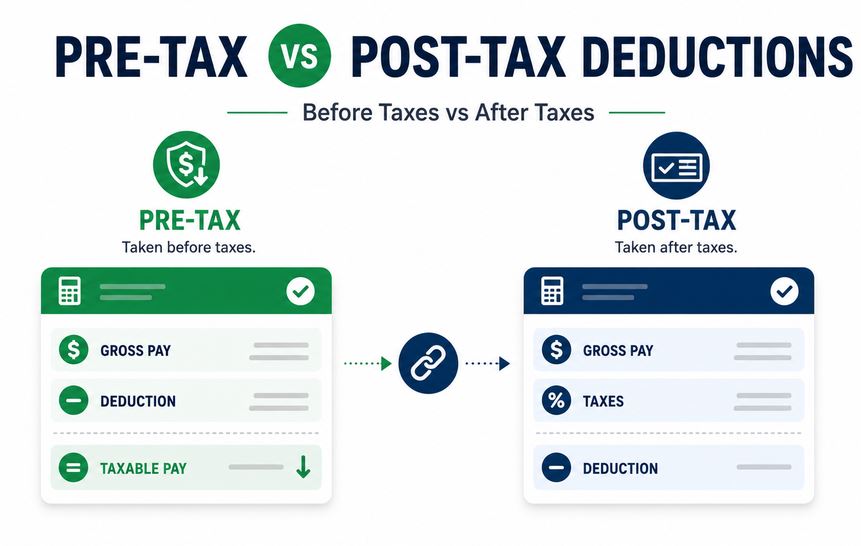
These come out of your gross pay before tax is calculated, which lowers your taxable income. That’s what makes them valuable. Here’s how pre-tax deductions cut your taxes.
- 401K / 401(K): Your traditional retirement contribution.
- 403B: The nonprofit and public-sector version of a 401(k).
- HSA: Health Savings Account contribution.
- FSA: Flexible Spending Account for medical costs.
- DCFSA / DCA: Dependent Care FSA for childcare costs.
- MED / DEN / VIS: Medical, dental, and vision insurance premiums, when taken pre-tax.
- CAFE / CAFE 125 / SEC 125: A cafeteria plan under Section 125 of the tax code. This label means your benefit premiums are being taken pre-tax. It’s not a fee, it’s the tax status of the deduction.
- POP: Premium Only Plan, another pre-tax premium arrangement.
Post-tax deduction codes (taken after taxes)
These come out after taxes are figured, so they don’t reduce your taxable pay.
- ROTH / ROTH 401K: After-tax retirement contribution that grows tax-free.
- GARN: A wage garnishment, a court-ordered deduction for a debt.
- CHSPT / CS / IWO: Child support withholding.
- LEVY: A tax levy, usually the IRS or state collecting unpaid taxes.
- UNION / UD: Union dues.
- LIFE / GTL: Life insurance. GTL means Group Term Life, and the cost of coverage above $50,000 gets added to your taxable income as imputed income.
- LOAN / 401K LOAN: Repayment of a loan taken against your retirement account.
Summary codes (your totals)
These tie the whole stub together.
- CUR / CURRENT: The amount for this pay period.
- YTD: Year to Date, your running total for the year. This is the number that matters at tax time, and here’s what YTD means and how to use it.
- NET / NET PAY: Your take-home, what actually lands in your account after every deduction.
- DD / CHK: Direct Deposit or Check, how you’re being paid.
New for 2026: codes tied to the latest tax law
A couple of newer codes are worth knowing, because older glossaries don’t have them. On your W-2, Box 12 now includes:
- Code TP: Your reported tips tied to the new “no tax on tips” deduction.
- Code TT: Qualified overtime tied to the “no tax on overtime” deduction.
These show up on your year-end W-2 rather than every pay stub, but they connect directly to what your stub recorded all year. Here’s a full guide to the W-2 boxes and Box 12 codes if you want to match your stub to your W-2.
How to use the codes to spot an error
Reading the codes isn’t just trivia, it’s how you catch mistakes. A few quick checks:
- Add your earnings codes. They should equal your GROSS line.
- Check that OASDI is about 6.2% of your gross and MED is about 1.45%. If they’re way off, something’s misclassified.
- Confirm your pre-tax deductions actually sit above the tax lines. If a benefit you expected to be pre-tax is being taxed, your take-home is lower than it should be.
- Watch your YTD totals climb steadily. A number that jumps or resets mid-year is worth a question to payroll.
If you’re building your own stubs as a contractor or small business owner and want every code labeled clearly and correctly, a pay stub generator like ePaystubs produces itemized stubs that lenders and landlords accept, with the taxes and deductions laid out the way they should be.
Keeping it real
No two employers use the exact same abbreviations. One stub says OASDI, another says SS, a third says Soc Sec, and they all mean Social Security. The codes above cover the ones you’ll see most, but if your stub has a label that isn’t here, don’t guess, ask your payroll or HR department what it maps to. It’s your money, and you’re allowed to understand every line. The goal isn’t to memorize a hundred acronyms, it’s to know which of the five buckets a code belongs to, because that tells you what it’s doing to your paycheck.
FAQ
What does OASDI mean on my pay stub? OASDI is the Social Security tax, 6.2% of your wages in 2026 up to a $184,500 cap. Some stubs label the same line SS or Soc Sec.
What is CAFE 125 on my paycheck? It’s a Section 125 cafeteria plan, which means your benefit premiums (like health insurance) are being deducted pre-tax. It’s a tax status, not an extra charge, and it lowers your taxable income.
Why are there two Medicare or Social Security lines? Usually your stub is showing the employee portion, and sometimes the employer match is displayed separately for transparency. You only pay your half.
What’s the difference between CUR and YTD? CUR (current) is the amount for this one pay period. YTD (year to date) is your running total for the whole year, which is what you use to check against your W-2.
My stub has a code that isn’t on this list. What do I do? Codes vary by employer and payroll system. Ask your payroll or HR department what the label means, since they set it up and can confirm exactly what it covers.
The short version
Every pay stub code fits into one of five groups: earnings (REG, OT, HOL), taxes (FIT, OASDI, MED, FICA, SIT), pre-tax deductions (401K, HSA, CAFE 125), post-tax deductions (ROTH, GARN, union dues), and summary totals (CUR, YTD, NET). Sort any abbreviation into its bucket and you’ll know what it’s doing to your pay. Check that your earnings add up to gross, that OASDI is 6.2% and Medicare is 1.45%, and that your YTD climbs steadily. If a code isn’t listed here or the math looks off, ask payroll, because you have every right to read your paycheck in full.
This article is general information, not tax, legal, or financial advice. Pay stub labels, deduction rules, and tax figures vary by employer and state and can change, so confirm the details on your own stub and check your specific situation with a qualified professional.


